Electric and Opening Rooflights
A rooflight you can open from where you are standing. Most of the decision is about wiring and where the actuator lives, not about the remote.
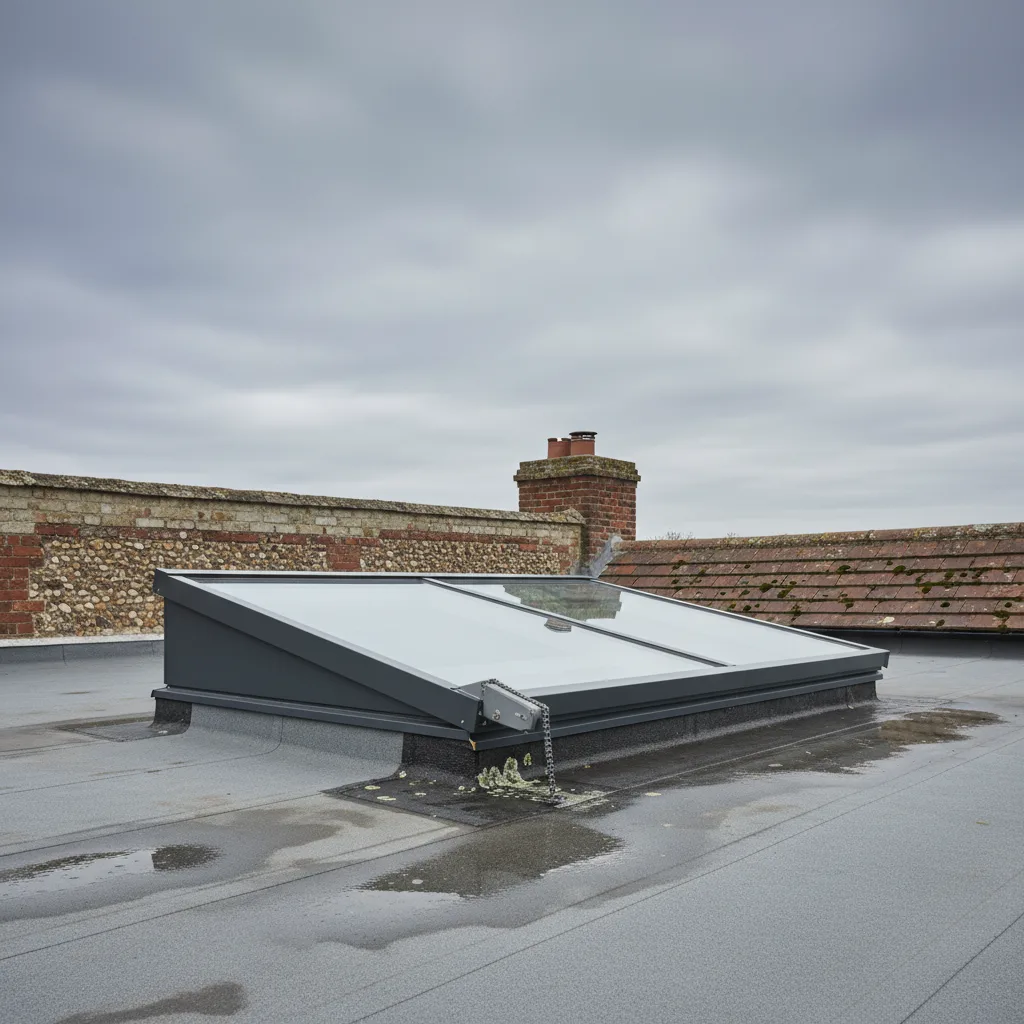
An electric rooflight is a rooflight you can open from where you are standing. That sounds like a convenience and on a flat roof it is usually a necessity, because the unit is above reach by definition and a pole only works if there is somewhere to stand and something to hook.
The actuator

Almost every opening rooflight uses a chain actuator: a motor drives a stiff articulated chain out of a housing, and the chain pushes the sash open. The chain is rigid in compression, which is what lets a small motor lift a heavy glazed sash.
The housing sits either on the frame or recessed into it. Recessed is neater and costs more. Either way it needs a power feed, and where that feed comes from is the decision that shapes the whole job.
Wiring, and why it matters when

During a build or an extension, running a cable to the rooflight position is trivial. It happens at first fix, before the ceiling goes on, and adds almost nothing.
After the ceiling is on, the same cable is a disruptive job: lifting boards, chasing, making good. This is the single most common regret we hear. Someone fits a manual rooflight to save a few hundred pounds, then wants it motorised two years later and finds the wiring costs more than the upgrade would have.
If there is any chance you will want an opener, run the cable at first fix even if you fit a manual unit. A capped cable in a ceiling void costs almost nothing and is worth a great deal later.
Solar, for retrofits

Solar powered openers carry their own panel and battery and need no mains feed at all. That makes them the usual answer where the ceiling is already finished. They open more slowly and cost more than a mains unit, and they work perfectly well in Essex, including on a north facing slope, because the panel needs daylight rather than direct sun.
Rain sensors

A rain sensor closes the rooflight when it detects water. It is not a weather forecast: it reacts to the first drops, which means the unit is closing while the rain is starting rather than before it.
On a rooflight above a kitchen or a bathroom, where you might leave it open and go out, it is worth having. On a unit you only ever open while you are in the room, it is optional. Where it earns its money is stopping a small mistake becoming a wet floor.
Controls

A handheld remote is standard. A wall switch is better for a room you use daily, because the remote is always in another room. Most systems support both, and it is worth fitting a wall switch at first fix while the cable is accessible.
Smart home integration exists and works, though it is worth being clear that it adds a dependency: a rooflight that opens by app is a rooflight that does not open when the hub is down. A physical switch alongside it is not a luxury.
Power cuts

An electric rooflight in a power cut stays where it is. It does not fall closed and it does not spring open. Most units have a manual override, either a detachable crank or a release that lets the chain be pushed back, and it is worth being shown where it is at handover rather than looking for it in the dark.
Ventilation, properly

The reason to open a rooflight is stack effect. Warm air rises, and an opening at the highest point of a room lets it leave, drawing cooler air in through lower openings. That is far more effective than a window in a wall, and it is why a single opening rooflight can cool a kitchen that two open windows cannot.
Which is also why an opening rooflight is worth more in a kitchen than solar control glass alone, and why the two together are the right answer for a south facing extension.
What it costs, and where the range comes from

Two separate costs, and only one of them is predictable.
The unit carries a modest premium over a fixed one for the actuator, the control gear and the heavier frame and hinges. Add a rain sensor and a wall switch and the premium grows a little. This part is comparable between quotations.
The wiring is where the range is. During a build, at first fix, a cable to the rooflight position is a few metres clipped to a joist before the plasterboard goes on: twenty minutes. Into a finished room it means lifting flooring above or ceiling below, chasing a wall for a switch drop, making good and redecorating: a day and a half plus decoration.
The same window, the same actuator, and a completely different job.
The single most common regret in this trade
Fitting a manual unit during a build to save the electric premium, then wanting a motor two years later and finding the wiring costs more than the upgrade would have.
Run a capped cable to the position at first fix even if you fit manual. It costs almost nothing, it is terminated in an accessible enclosure, and it turns a disruptive job into a cheap one. Photograph where it is before the ceiling goes on.
Where solar wins
A solar powered opener carries its own panel and battery and needs no mains connection at all. Fitting is a couple of hours with no disruption below.
That makes it the usual answer for retrofitting into a finished room, and for period and listed property where running cable through historic fabric is disruptive and sometimes itself restricted.
It works here better than people expect. The panel needs daylight rather than direct sun, and the energy to open a window a few times a day is small, so it works on a north facing slope and through an East Anglian winter. It opens more slowly than mains, thirty to sixty seconds against fifteen to thirty, which nobody notices in use. The battery is a consumable good for several years and it is replaceable.
It is also unaffected by a mains power cut, which mains units are.
Controls, and why the wall switch matters
A handheld remote comes with most systems. It is convenient and it is permanently in another room.
A wall switch is the one people skip and then wish they had. It is always in the same place, anyone can use it without being shown, and it works when a battery is flat. It needs a cable, which is why it has to be decided at first fix, and it belongs with the light switches at the room entrance rather than under the rooflight.
Smart home integration works and adds a dependency: a rooflight that opens by app is a rooflight that does not open when the hub is down, the network is out, or a manufacturer changes something. Over a twenty five year life none of those is unlikely. A physical control alongside it is not a luxury.
Power cuts and the manual override
A chain actuator holds its position mechanically, so a cut leaves the window exactly where it was. Nothing falls shut and nothing springs open.
The scenario worth planning for is open when the power goes, and then it rains, because the rain sensor needs power too. Most units have a manual override: either a detachable crank that winds the chain in, or a release that lets the sash be pushed closed by hand.
Find out which yours is at handover and keep the crank somewhere memorable. On a rooflight above reach the crank needs a pole, and it is worth confirming you own one before you need it in the dark.
Maintenance
Four things once a year, and the first matters most.
Clean the gasket. Grit, leaves and moss on the compression seal stop the sash seating properly. Two consequences: it lets water past, which gets reported as a leak, and the actuator works harder every cycle against an obstruction, which shortens its life.
Lubricate the chain where it extends from the housing. Light oil or a dry PTFE spray, not grease, which collects grit.
Wipe the rain sensor. A dirty sensor either misses rain or reads permanent moisture from grime and refuses to let the window open at all, which looks exactly like a fault.
Cycle it fully a few times a year, including in winter. Mechanisms that sit unused seize.
An actuator is the shortest lived component on the window, ten to fifteen years against twenty five for the glazing. It is also a serviceable part that unbolts and is swapped, which is a fraction of the cost of a new window, and our guarantee covers the labour where we fitted the original.
Ventilation, and what one opening rooflight does to a room
The reason to motorise a rooflight is rarely the novelty. It is that a high level opening does something no window in a wall can do.
Warm air rises. An opening at the highest point of a room lets it leave, and as it leaves it draws cooler air in through anything open lower down. That is stack ventilation, and with a rooflight open and a door or window open at low level a room clears in minutes rather than hours. A wall window on its own mostly exchanges air with the still layer just outside it.
It matters most in exactly the rooms rooflights go into. A kitchen extension with glazing overhead gains heat through the day and has nowhere to lose it. A loft room sits under the roof and collects everything that rises through the house. In both, an opening rooflight is the difference between a room that is used in July and one that is not.
The practical version is night purge. Open it late, let the accumulated heat out of the building overnight, close it in the morning before the outside air warms up. On a rain sensing motorised unit that happens without anyone thinking about it, which is the actual argument for a motor over a pole.
Building Regulations Part F sets purge ventilation requirements for habitable rooms, and an opening rooflight contributes to that provision. It is worth confirming the open area figure for the specific model at design stage, because a top hung unit and a centre pivot of the same size do not offer the same free area.
None of this works if the rooflight is the only thing open. The inlet at low level is half the system, and a room with one opening and no other is a room where very little moves.
| Option | How it is operated | Where it suits | Decide it at |
|---|---|---|---|
| Fixed | Not applicable | Daylight only, where ventilation comes from elsewhere | Order |
| Manual, pole operated | A pole from floor level | Pitched roofs within reach of a pole | Order |
| Electric chain actuator | Wall switch or remote | Flat roof units, and anything out of reach | Order. The cable route has to exist before the ceiling closes |
| Electric with rain sensor | Closes itself when it starts raining | Any opening unit nobody is watching | Order |
| Smoke or heat vent | Automatic on detection, plus manual override | Where a stairwell or protected route needs venting | Design, with the Building Control body |
| Escape rooflight | Manual, opening to a clear escape dimension | Habitable loft rooms, where it is required | Design. It cannot be added later without a new unit |
From quote to daylight, with no surprises
Fixed quote
A clear, fixed written price, online or by phone.
Survey
A specialist confirms the right glazing spec. Flexible times.
Install
Clean, weather-tight fitting that protects your property.
Guarantee
We tidy up and back the work with a written guarantee.
Frequently asked questions
Do electric rooflights need an electrician?
The connection to a mains supply does. The rooflight itself is fitted by us, and where the feed already exists at the right point the connection is straightforward. Where a new circuit is needed, that is electrical work and is priced as such.
What happens in a power cut?
It stays where it is. It does not fall closed or spring open. Most units have a manual override, usually a detachable crank or a chain release, and we show you where it is at handover rather than leaving you to find it in the dark.
Can you convert a manual rooflight to electric?
Sometimes, if the frame is designed for it and there is a route for power. Where the ceiling is finished, a solar powered opener is usually the cheaper and less disruptive answer than running a new cable.
Are they noisy?
A chain actuator makes a low mechanical hum for the fifteen to thirty seconds it takes to open. It is quieter than an extractor fan and it is not running continuously. Nobody who has one mentions the noise a year later.
Do you need a rain sensor?
It depends whether you will ever leave it open unattended. On a kitchen or bathroom rooflight, yes. On one you only open while you are in the room, it is optional. It reacts to the first drops rather than predicting rain, so it closes as the rain starts.
Helpful reading on this
Costs, comparisons and answers to the questions we’re asked most.
Other skylight services
Ready to bring the daylight in?
Tell us about your project and we’ll send a clear, fixed written quote, no pressure, no surprises.
- Fixed written price before any work starts
- No pressure, no obligation, no sales calls
- Flexible survey times that suit you
- A reply within one working day