Replacing a Failed or Misted Rooflight
Misted, leaking or thirty years old. Like for like where the kerb allows it, and a straight answer where it does not.
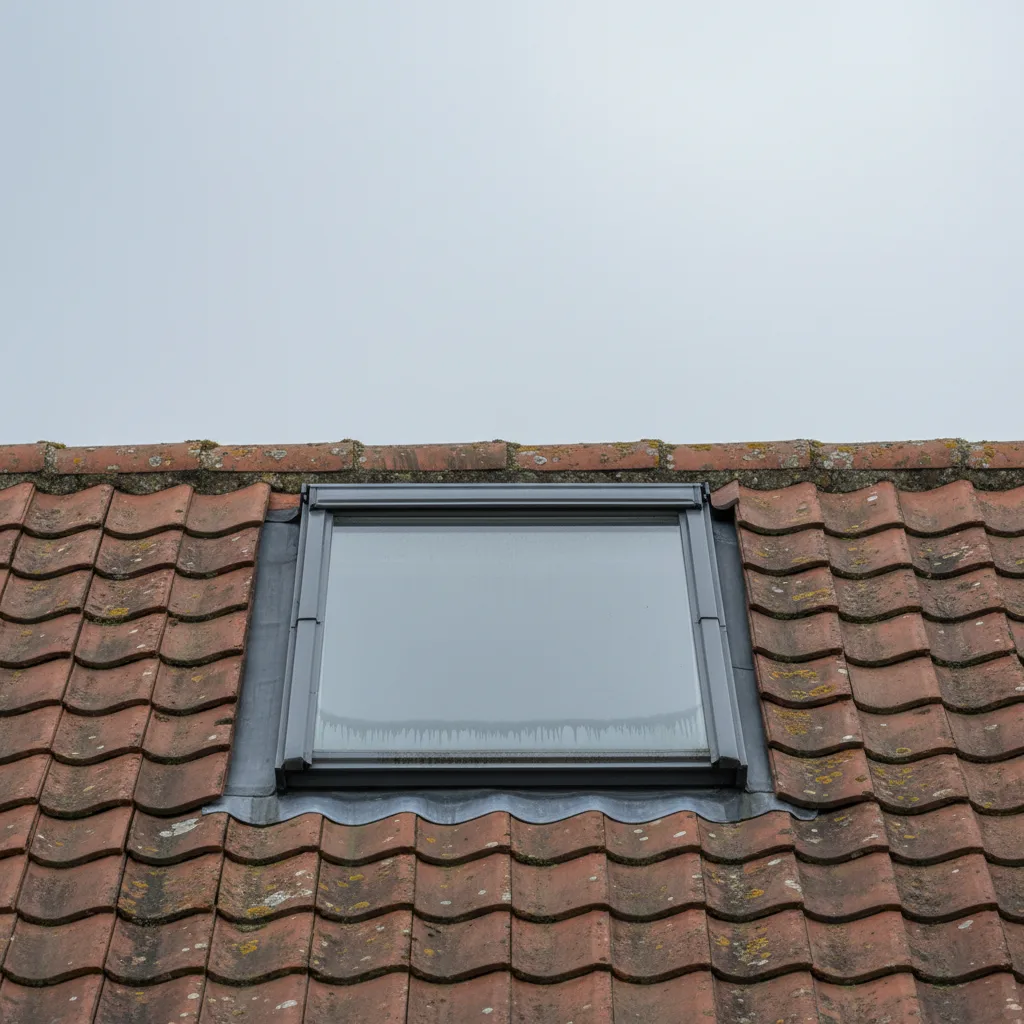
Three things decide what a rooflight replacement costs and how long it takes, and none of them is the unit itself: whether the existing opening can be reused, what condition the timber around it is in, and how you get to it.
Why sealed units mist

A double glazed unit is two panes with a sealed cavity between them, and the seal has a life. When it fails, moist air gets into the cavity, and when the glass is cold that moisture condenses on the inside where nobody can clean it. That is the haze, and it is permanent.
Overhead units fail sooner than windows for two reasons. They see more thermal cycling, going from cold at dawn to hot by midday. And water sits on them rather than running off, so the seal is wet more of the time. Twenty to twenty five years is a fair life for an overhead unit; the ones failing in Colchester now were largely fitted in the late 1990s and early 2000s.
A misted unit is not an emergency. It is not leaking, and nothing is getting into the building. It is ugly and it has lost most of its insulating value, so it is worth planning rather than panicking about.
Can the opening be reused

This is the question that decides the price.
On a pitched roof, if the replacement is the same size code, the opening is reused and it is a straightforward job. If the size is obsolete, the options are the nearest current size with minor carpentry, another manufacturer at the old dimension, or reframing.
On a flat roof, the kerb decides it. A sound, square, correctly sized kerb takes a new unit directly. A kerb that has rotted at the corners, or was built out of square, or is too low for the covering to have terminated properly, has to be rebuilt. Rebuilding a kerb means disturbing the roof covering around it, and that is a different job with a different price.
We survey the kerb before quoting. A price given over the phone for a flat roof replacement is a guess about the kerb.
What is found when the old unit comes out

Often nothing, and the job runs to plan. Sometimes the timber around the opening has gone soft, because a unit that has been failing for years has usually been letting a little water past for some of them.
Soft timber has to be cut out and replaced. There is no version of this job where it is acceptable to bolt a new unit to rotten timber. We flag it as a possibility at quotation with an indication of what it would add, so that if it happens it is a known risk rather than a surprise invoice.
Access

Single storey flat roofs are usually reached from a tower or a ladder and cost nothing extra. Second storey and above, or anything over a conservatory or a fragile roof, usually needs scaffold, and scaffold is a real cost that belongs in the quotation rather than appearing later.
Where several rooflights need replacing, doing them in one visit shares the access cost across all of them. Two units done together are meaningfully cheaper than two units done a year apart, and that is the main argument for doing them all at once.
The upgrade you get for free

A unit fitted twenty five years ago has no low emissivity coating, no argon, an aluminium spacer, and no solar control. The replacement has all four as standard. The room will be warmer in winter, cooler in summer and quieter in rain, and none of that is an optional extra.
Winter

Replacement in winter is entirely normal. The roof is open for a matter of hours, not days, and it is made watertight before we leave regardless of what stage the job is at. What winter does change is the weather window: a driving rain day gets rescheduled rather than worked through, and we would rather move a date than open a roof badly.
What a replacement costs, and what moves it

An indicative range by email from a photograph of the data plate, then a fixed written price after survey. On a flat roof we will not price without seeing the kerb.
Whether the opening is reused. A like for like swap into a sound opening is the cheapest job in this trade. Altering it is a different order of work.
Access. Frequently the biggest surprise. Single storey from a tower costs nothing extra; a second storey or a front elevation over a road generally means scaffold.
The covering. Slate and plain tile are straightforward. Profiled tiles need a deep flashing kit. Obsolete or fragile tiles that break when lifted have to be sourced.
What is found. Soft timber has to be cut out and replaced.
Doing several together
The single best way to reduce cost per unit. Access is a fixed cost shared across everything done in the same visit, so two done together are meaningfully cheaper than two done a year apart.
If several went in at the same time they will fail at about the same time. If two of three are misted, ask what the third costs while the scaffold is up. It is usually much less than doing it separately in two years, and it will need doing.
Can the glass alone be replaced

It depends on the model, and then on whether it is a good idea.
Some pitched roof windows have a sealed unit held by a removable glazing bead, so the glass can be changed with the frame in place. On others the glass is bonded into the sash as one component and the sash is replaced. On most flat roof rooflights the glass and frame are a single bonded unit and the answer is no.
Whether it is worth doing is the second question. A twenty five year old window has hardened seals, worn hinges, a finish at the end of its life and thermal performance two generations behind current. New glass in that frame gives you modern glazing in a worn window, and the labour and access are nearly identical either way, because most of the cost of this job is getting to the window rather than the component.
Frame under fifteen years and sound: replace the glass. Over twenty years: replace the window. Any timber decay: replace the window, always.
Drilling and drying
Some companies drill a misted unit, dry the cavity and fit small vents. The visible misting clears. The seal is not restored, the argon has gone and is not coming back, and the unit now deliberately breathes outside air with a desiccant that is already spent.
On an overhead unit at height the labour to do that is most of the labour to replace it properly. We do not offer it.
Matching, when only one has failed
Replacing one window out of three on a visible slope raises a question the price list does not answer: will it look like the others.
Cladding colours have changed several times, sightlines have generally slimmed so a modern unit shows more glass and less frame, and older units often sit differently relative to the covering.
On a rear slope nobody sees, accept the difference. Where the manufacturer offers it, matching the cladding colour gets you most of the way for very little. On a front elevation, replacing them all is frequently better value than it first sounds, because the others are the same age and the access is shared.
Where a property is listed or in a conservation area, a replacement may be conditioned to match the existing, and that is worth establishing before anything is ordered.
Reading a replacement quotation
Quotations for the same job can differ by a factor of two, and the difference is usually in what is not written down. Eight things should be itemised.
- The unit: manufacturer, model, size code and glazing specification.
- The flashing kit, and which profile. Where cheap quotations economise.
- The insulation collar. A separate order line, frequently omitted, and its absence shows as reveal condensation months later.
- Access: scaffold or tower, and who provides it.
- Making good, to what standard, and whether decoration is included.
- Disposal of the old unit.
- Building Control, where notifiable, and who notifies.
- The contingency for decayed timber, with an indication of cost.
Two guarantees matter and they are different things: the manufacturer’s warranty on the product, and the installer’s guarantee on the workmanship. Most problems are installation problems, so the second is the one to ask about.
Why units mist in the first place
A sealed unit is two panes with a gas filled cavity between them, held apart by a spacer bar containing a desiccant that absorbs the small amount of moisture sealed in at manufacture. Around the outside, a perimeter seal keeps the gas in and the weather out.
That seal is doing harder work on a rooflight than on any window in the building. It is horizontal or near horizontal, so it sits under standing water rather than shedding it. It faces the sky, so it takes the full temperature swing of a clear night and a sunny afternoon, and the cavity gas expands and contracts against it every single day for decades. That daily pumping is what eventually works the seal loose.
Once air can get in, the desiccant absorbs moisture until it is saturated, which takes a while and is why misting appears suddenly years after the seal actually went. After that, every cold morning condenses water on the inside of the outer pane and you can see it.
Two things follow. The argon has gone, so thermal performance has quietly dropped back toward a plain double glazed unit. And once the cavity is wet, the low emissivity coating starts to degrade, which is what produces the permanent bloom that does not clear even on a warm dry day.
Fifteen to twenty five years is a normal life for a rooflight sealed unit. Earlier than that usually points at something specific: standing water from a kerb with no fall, an installation that trapped the unit rigidly so it could not move thermally, or a manufacturing batch problem.
Misting is not a safety issue and nothing is going to fall out of the roof. It is a performance and appearance issue, and it does not improve on its own.
| What you see | When it happens | Most likely cause | What it needs |
|---|---|---|---|
| Misting between the panes | Any time, worse in sun | The sealed unit has failed and the cavity is breathing | A new sealed unit, or a whole unit if the frame has gone too |
| Damp patch on the ceiling | During and after rain | A genuine water path, usually the flashing or the kerb termination | The weathering detail corrected, not the glass replaced |
| Damp patch on the ceiling | Cold dry weather, worst in the morning | Warm moist air reaching a cold surface. The vapour control layer is not sealed to the frame | The build-up corrected at the kerb. New glass will not touch it |
| Water running down the inside of the frame | Cold weather, in a kitchen or bathroom | Surface condensation on the frame itself | Ventilation, and a frame with a proper thermal break |
| Draught, or the unit will not close on to its seal | All year, worse in wind | Perished gaskets, or a frame that has moved with the opening | Replacement. A thirty year old frame is at the end of its life |
| Staining on the plaster reveal only | After driving rain from one direction | The underlay collar was never dressed to the frame | The kit re-detailed at the head and sides |
From quote to daylight, with no surprises
Fixed quote
A clear, fixed written price, online or by phone.
Survey
A specialist confirms the right glazing spec. Flexible times.
Install
Clean, weather-tight fitting that protects your property.
Guarantee
We tidy up and back the work with a written guarantee.
Frequently asked questions
Is a misted rooflight an emergency?
No. A misted unit is not leaking and nothing is getting into the building. It is ugly and it has lost most of its insulating value. It is worth planning rather than rushing, and doing it alongside any other units that are close to the end of their life.
Can you replace just the glass?
On a pitched roof window, sometimes, if the model has a replaceable sealed unit and the frame is sound. On a flat roof rooflight the glass and frame are usually one bonded component, so the answer is normally no. Replacing glass into a failed frame is money wasted either way.
What if the timber around the opening has gone soft?
It gets cut out and replaced. A unit that has been failing for years has usually been letting a little water past for some of them, so it is a real possibility rather than a remote one. We flag it at quotation with an indication of cost so it is a known risk, not a surprise.
Should I replace all my rooflights at once?
If they were fitted at the same time, they will fail at roughly the same time, and the access cost is shared across all of them in one visit. Two done together are meaningfully cheaper than two done a year apart.
Can rooflights be replaced in winter?
Yes. The roof is open for hours rather than days and is made watertight before we leave whatever stage the job has reached. What changes is the weather window: a driving rain day gets rescheduled rather than worked through.
Helpful reading on this
Costs, comparisons and answers to the questions we’re asked most.
Other skylight services
Ready to bring the daylight in?
Tell us about your project and we’ll send a clear, fixed written quote, no pressure, no surprises.
- Fixed written price before any work starts
- No pressure, no obligation, no sales calls
- Flexible survey times that suit you
- A reply within one working day